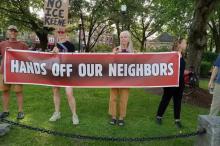
“Terrible things are happening outside. Families are torn apart; men, women and children are separated. Children come home from school to find that their parents have disappeared. . . Everyone is scared.”
~Anne Frank, The Diary of a Young Girl
Wait. What? Is this a description of what is currently happening all over America, now just recently right here in Keene, New Hampshire?
Nope.
These were horrific events taking place in 1940’s Netherlands, described by a young Jewish girl kept hidden along with her family in Amsterdam, which was then occupied by the Germans. This genocide became known as the “Holocaust,” Adolf Hitler's attempt to exterminate an entire race.
Genocide: the deliberate and systematic destruction of a group of people because of their ethnicity, nationality, religion, or race.
Holocaust: destruction or slaughter on a mass scale, especially caused by fire or nuclear war.
During that terrible time in global history, there were people who saw and knew what was happening to their fellow human beings was wrong, evil. These brave folks took action by assisting those being persecuted by hiding them or getting them out of the country, knowing it was not safe for themselves to do so.
We have seen such acts of bravery here, in our own country. Human beings assisting fellow human beings, knowing it was not safe for themselves to do so. The Underground Railroad comes to mind. . .
Throughout the 17th and 18th centuries, human beings were abducted from the African continent by slave ships to be brought to the “New World,” sold as “merchandise,” thus becoming the “property” of their white master.
Of course, this was IF they survived crossing the ocean, a harrowing trip which could last anywhere from two to four months. Chained together and tightly packed in belowdecks, many died from malnutrition, murder, suffocation or suicide. An estimated 2.2 million Africans died during these horrific trips.
The “Underground Railroad” was created during the early to mid-1800’s and was a system of safe houses and hidden travel routes utilized by Black slaves escaping to free states in the north or to Canada. Other routes went into Mexico, where human bondage had already been abolished. By 1850, it is estimated about 100,000 human beings escaped their life of slavery through the Underground Railroad.
Besides John Brown, Levi Coffin and Frederick Douglass, the most famous “conductor” was Harriet Tubman, who was so successful she became known as “Moses,” a name given to her by abolitionist William Lloyd Garrison. It also led to a $40,000 reward posted for her capture, dead or alive.
And we are now seeing similar situations happening here in America. Immigrants to our country, some seeking legal asylum, others on work or school visas are now reduced to living in fear for their lives. Even those who were born here, whose families have lived here for generations, are being targeted.
This has all been planned in Project 2025, laid out in the chapter on immigration.
This past week in Keene, ICE came in and snatched a young man from Equador. He has a wife, three young children, a job and is here legally. Understandably, there is uncertainty and fear amongst the immigrant community because “Terrible things are happening outside.” NH activists warn of increased ICE activity in state | New Hampshire Public Radio
Earlier this year, people spoke up against the proposed ICE detention center in Merrimack and residents in Keene have been peacefully protesting the “disappearing” of valued members of our community. Embarrassingly, as of mid‑2026, NH is the only New England state that has local law enforcement agencies participating in the task force model of ICE’s 287(g) program, authorizing municipal and state police and county sheriffs to carry out certain immigration enforcement duties alongside ICE.
While the current regime and Free Staters in the NH legislature have been successful in getting rid of Diversity, Equity and Inclusion (DEI) mandates, it is the bravery of individuals and organized groups who continue to speak up and protect those who seek only safety and opportunity in the United States. Let’s grow that group of people.
The following are quotes from Native Americans in response to their land being forcefully taken by white European IMMIGRANTS.
“How smooth must be the language of the whites, when they can make right look like wrong, and wrong like right.” Black Hawk, Sauk
“Only after the last tree has been cut down, only after the last river has been poisoned, only after the last fish has been caught, only then you will find that money cannot be eaten.” Cree Indian Prophecy
“They made us many promises, more than I can remember, but they never kept but one; they promised to take our land, and they took it.” Chief Red Cloud, Oglala Lakota