
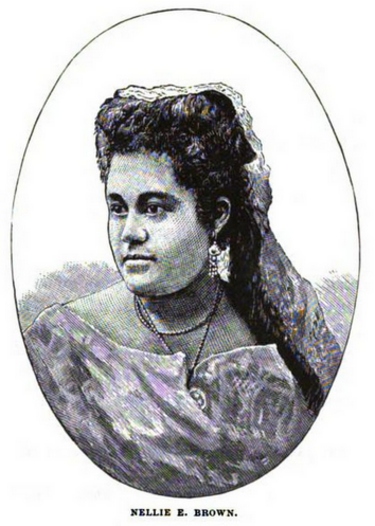
Nellie E. Brown Mitchell was born in Dover, New Hampshire in 1845 (exact date unknown). She was trained as a singer at the New England Conservatory of Music, receiving a diploma in 1879. Nellie was a popular singer in New England churches and was lead soprano at four churches in Boston. She also found time to give concerts throughout New England and beyond, one 1874 concert was at Steinway Hall in New York City. Her sister, Edna Brown Bagnall, was also a singer, sometimes joining her in concerts.
During the 1880s, Nellie not only toured with the Bergen Concert Company, but formed her own company, the Nellie Brown Mitchell Concert Company. In Boston she was musical director at Bloomfield Street Church from 1879 to 1886. She sang at the funeral of abolitionist William Lloyd Garrison in 1879. She also sang at the 1909 first meeting of the National Negro Business League, (founded by Booker T. Washington) in Boston.
Nellie then went on to teach voice techniques to African-American women students in Boston after retiring from touring. In 1909, she organized and hosted the first meeting of the Chaminade Musical Club, for the leading women musicians of Boston (named for French composer Cecile Chaminade.)
She married Charles Lewis Mitchell, (date unknown) a disabled veteran of the Civil War. Charles was one of the first two African-American members of the Massachusetts legislature, passing away in 1912. Nellie died on Jan. 5, 1924, at the age of 78.
Nellie and Edna’s brother, Edward Everett Brown, was also born in Dover in 1858 (exact date unknown), graduating from Dover High School in 1878. Edward studied at Dartmouth College then turned his studies to law under the tutelage of NH judge John H. White. He continued his study of law at Boston University Law School working in the law office of ex-governor William Gaston. He was a lawyer and anti-lynching activist in Boston.
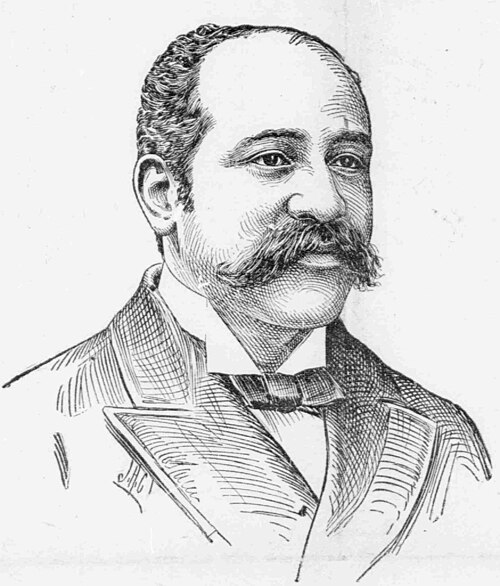
In 1884, Edward was admitted to the Massachusetts Bar. A year later he and a friend were denied entrance to a Boston roller skating rink, called Highland Rink. He and fellow lawyer James Harris Wolff took the rink owner to Municipal Court for racial discrimination and violating an1865 state law from the Reconstruction-era. They won the case, bringing additional cases against the rink a year later.
In 1886, Edward became a partner at the law firm Walker, Wolff, and Brown, joining Edwin Garrison Walker and James Wolff at what became known as Boston's first "colored" law firm. He was founding president of the Crispus Attucks Club in Boston and first vice president of the National League of Boston. He also worked as the Boston Deputy Health Commissioner and at the time of his death on Jan. 14, 1919, the Boston Deputy Collector.
The Black Heritage Trail unveiled a historical marker in 2023 at the entrance to the Pine Hill Cemetery in Dover, emphasizing the contributions of both Nellie and Edward.
“Wherever there is a human being, I see God-given rights inherent in that being, whatever may be the sex or complexion.”
—William Lloyd Garrison
“Change will not come if we wait for some other person or some other time. We are the ones we’ve been waiting for. We are the change that we seek.” (emphasis added)
—Barack Obama