
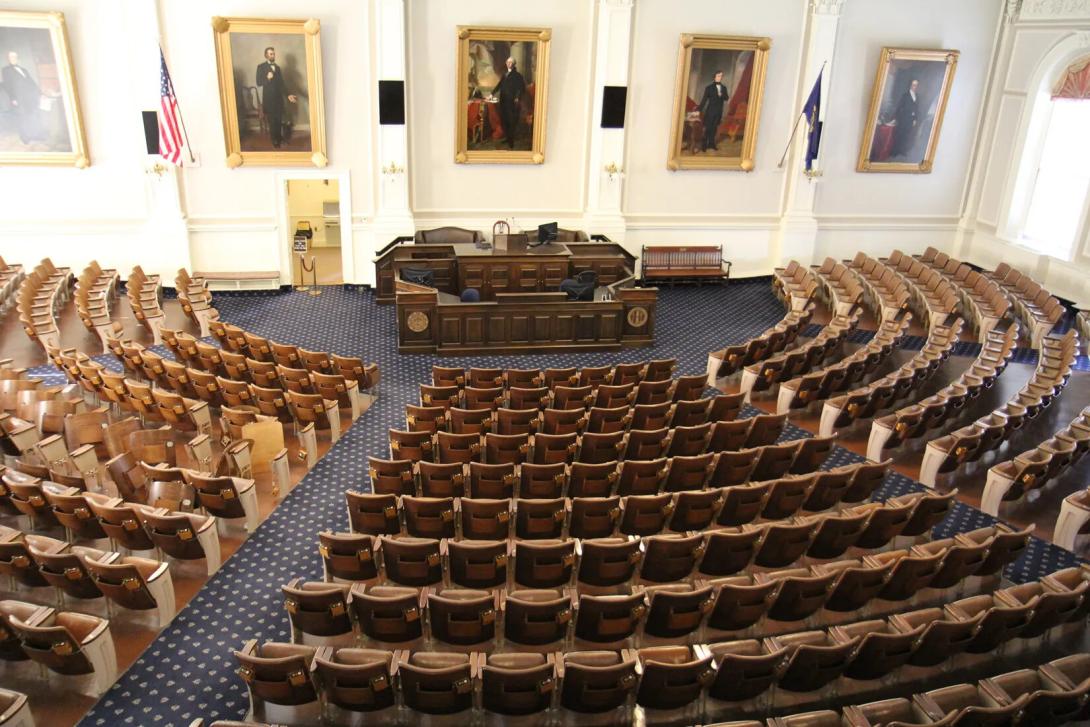
In a little over six weeks the newly elected and re-elected members of the New Hampshire Senate and House will be back in Concord. In respective committees, looking over proposed legislation, holding public hearings and debating merits of a bill before sending it to the full House with recommendations. In a nutshell, here’s the process:
~Introducing a Bill
LSR – A member files what is called a “Legislative Service Request” with an idea for a bill. That request then goes to -
OLS - Office of Legislative Services, where researchers and attorneys craft language that will come before the appropriate committee, eventually ending up on the House floor to be voted on. (Occasionally, an LSR is pulled by the sponsor for any variety of reasons.)
PRIME SPONSOR - Representative or Senator who proposes the legislation.
CO-SPONSOR - Representatives or Senators who support the legislation as introduced in the Public Hearing.
FISCAL NOTE/FN - Cost estimate attached to a bill indicating a fiscal impact. Example: funding a proposed program or project.
EXECUTIVE SESSION - Convening a committee to discuss and make a recommendation on the bill.
~Recommendations
OTP - Ought to Pass or OTP/A - Ought to Pass as Amended
ITL - Inexpedient to Legislate (fancy words for “kill the bill.”)
IS - Interim Study. A recommendation for a bill to be referred to a study committee before moving further in the process.
SPECIAL ORDER - In legislative or committee settings, a “special order” can be used to ensure a bill, motion, or issue is addressed at a specific time, regardless of other items on the agenda.
RE-REFER TO COMMITTEE - Recommendation used at times by Senate Comms. in the first year of legislative session Floor Action.
~Floor Actions
PARLIAMENTARY INQUIRY/PI - Request for information from the presiding officer regarding procedure.
POINT OF ORDER - Question raised by a member when there is doubt regarding procedure or a statement.
LAY ON THE TABLE/ LOT - Non-debatable motion to set aside (table) a bill until further action is taken.
VOICE VOTE/VV – Pretty self-explanatory.
DIVISION VOTE/ DIV - Counted by individual votes, not individual names.
ROLL CALL/RC - Recorded vote listing individual names.
~Referral to the Other Legislative Body
CROSSOVER - When bills originally introduced in the House move to the Senate and vice versa.
CONCUR, NON-CONCUR, NON-CONCUR W/COMMITTEE OF CONFERENCE - Options for the originating legislative body if original bill is amended.
COMMITTEE OF CONFERENCE - Small group of legislators, usually 4 House and 3 Senate members, selected by their respective officers and tasked with reconciling differences on the content of a bill that has passed both chambers.
~On to the Governor
ENROLLED - Action taken by OLS once a bill passes in both Chambers or comes out of Committee of Conference. The bill is sent to the Secy. of State who delivers it to the Governor.
SIGNING CEREMONY – Celebratory gathering of the Gov. signing a bill into law.
~Overriding a Veto
VETO - Return of a bill to the Legislature by the Gov. without an approving signature. Legislature may override a veto with a 2/3 majority vote.
RECALL - To summon a piece of legislation and return to the body last acting upon it.
~Citizen Participation
TESTIMONY - Oral and/or written support or opposition for a bill provided at the public hearing. Can also register to support or oppose for particular bills on the General Court Website.
CACR - Constitutional Amendment Concurrent Resolution is a proposed constitutional change requiring 3/5 margin of the entire membership of each chamber. CACRs pass directly to the voters for ratification by a 2/3 margin at the next general election.
“The cornerstone of democracy rests on the foundation of an educated electorate.” — Thomas Jefferson